

- Introduction — The Hidden Layer of the Birth Chart
- What the Navamsa Chart Represents
- The Relationship Between the Birth Chart and the Navamsa Chart
- Why the Navamsa (D9) Chart Is Considered the Most Important Divisional Chart
- Why the D9 chart Matters in Marriage
- Planetary Strength Revealed in the Navamsa (D9)
- Why Navamsa (D9) Becomes Stronger After Marriage or Later in Life
- Navamsa and Spiritual Maturity
- The Navamsa Chart and the Journey of the Soul
- Frequently Asked Questions About Navamsa (D9)
- Conclusion
Introduction — The Hidden Layer of the Birth Chart
We can begin with a reflective thought: Many people discover astrology through their birth chart. It reveals personality, talents, challenges, and the broad outline of life. But astrologers in the Vedic tradition often look deeper. Behind the birth chart lies another chart called the Navamsa Chart (D9), a chart that many consider to be the chart of the soul’s unfolding destiny.
While the birth chart describes the circumstances of life, the Navamsa (D9) chart reveals how those circumstances shape inner growth over time.
What the Navamsa Chart Represents
Here we explain the technical idea but keep the tone philosophical. The Navamsa in Vedic astrology is created by dividing each zodiac sign into nine equal parts. But its meaning goes far beyond mathematical divisions.
In deeper astrology, the Navamsa is often seen as the refined expression of planetary energies. Some astrologers say:
- The birth chart shows the path we are given
- The Navamsa shows how we grow while walking that path
This is why many astrologers carefully compare the birth chart with the Navamsa to understand how life evolves as a person matures.
The Relationship Between the Birth Chart and the Navamsa Chart
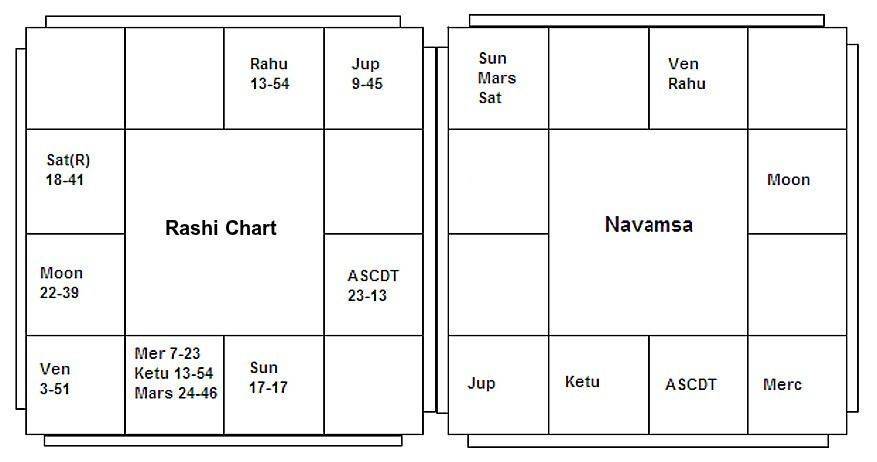
Another important way to understand the Navamsa chart (D9) is by comparing it with the birth chart (rashi chart).
The birth chart is often considered the foundation of life, showing the basic structure of personality and circumstances.The D9 chart, however, reflects a refined layer of that same structure.
Astrologers often study both charts together to understand whether a planet’s promise in the birth chart becomes stronger or weaker over time.
For example:
- A planet that appears strong in the birth chart and also strong in the D9 divisional chart may produce stable and reliable results in life.
- If a planet appears strong in the birth chart but weak in the D9 chart, its results may require patience, maturity, or inner effort to fully develop.
Through this comparison, the D9 Navamsa in Vedic astrology helps astrologers understand the deeper evolution of planetary influences.
Why the Navamsa (D9) Chart Is Considered the Most Important Divisional Chart
In Vedic astrology there are several divisional charts that reveal different aspects of life. Among them, the Navamsa (D9) Divisional Chart holds a special place.
Many classical astrologers consider it the most important divisional chart after the birth chart itself. This is because the Navamsa (D9) Divisional Chart connects multiple dimensions of life:
- relationships and marriage
- planetary strength
- long-term destiny
- spiritual development
Because of this wide scope, astrologers frequently turn to the D9 Navamsa when seeking a deeper understanding of how life experiences shape a person’s inner journey.
Why the D9 chart Matters in Marriage
Marriage occupies a special place in Vedic astrology. It is not only a partnership between two individuals but often understood as a karmic meeting of two life paths.
For this reason, astrologers frequently examine the Navamsa divisional chart when studying relationships. Planets connected with relationships, especially Venus and Jupiter, are carefully analyzed in the Navamsa chart.
Rather than simply predicting whether marriage will occur, the chart often reveals:
- the deeper nature of partnership
- emotional harmony within relationships
- the lessons relationships bring to the soul
Planetary Strength Revealed in the Navamsa (D9)
Another fascinating aspect of the Navamsa chart is how it reveals the true strength of planets. Sometimes a planet that appears powerful in the birth chart may appear weaker in the Navamsa chart, suggesting that its influence may require maturity or inner development to fully manifest.
In other cases, a planet that appears ordinary in the birth chart may reveal hidden strength in the Navamsa chart. Because of this, many astrologers believe the Navamsa chart represents the inner refinement of planetary energy over time.
Why Navamsa (D9) Becomes Stronger After Marriage or Later in Life
Many traditional astrologers believe that the influence of the Navamsa D9 chart becomes more noticeable as a person grows older. This idea comes from the observation that the D9 divisional chart reflects the deeper maturity of the soul, and maturity often develops through life experiences such as relationships, responsibilities, and personal transformation.
The birth chart often reflects the conditions we are born into the family environment, early opportunities, and the initial direction of life.
But the Navamsa divisional chart is sometimes described as the chart of inner maturity. As people move through important life experiences, especially marriage, responsibility, and personal transformation, the deeper qualities represented in the D9 chart begin to unfold more clearly.
This is why some astrologers say that the Navamsa chart reveals how a person grows into their destiny, rather than simply describing what happens in life.
Navamsa and Spiritual Maturity
Perhaps the most profound dimension of the Navamsa chart is its connection with spiritual growth. In Vedic Astrology, life is often understood as a journey of the soul through experience, learning, and self-discovery.
The D9 divisional chart reflects how a person gradually develops deeper awareness through the events and relationships of life. Over time, the external circumstances shown in the birth chart can become opportunities for inner transformation and wisdom.
In this sense, the D9 chart is sometimes described as the chart of the soul’s maturity.
Some astrologers describe the relationship between the birth chart and the Navamsa chart in a beautiful way: The birth chart shows the promise of life, while the Navamsa chart shows the fulfillment of that promise.
By studying both charts together, astrologers seek to understand not only what may happen in life, but how those experiences shape the evolution of the soul.
Why Many Astrologers Say Navamsa Becomes Stronger After Marriage or Later in Life
The Navamsa Chart and the Journey of the Soul
One of the most beautiful interpretations of the Navamsa chart is its connection with the journey of the soul.
In the philosophy behind Vedic Astrology, life is not only about external success or failure. It is also about learning, growth, and the gradual awakening of deeper awareness.
The D9 divisional chart can be seen as a symbolic map of how the soul refines itself through the experiences of life. Relationships, challenges, and personal transformations all play a role in this process.
When astrologers study the D9 chart, they are often trying to understand how a person’s life experiences contribute to inner evolution. In this sense, this D9 divisional chart reminds us that astrology is not merely about predicting events — it is also about understanding the deeper meaning behind those events.
Frequently Asked Questions About Navamsa (D9)
What is the Navamsa chart in Vedic astrology?
The Navamsa, also known as the D9 chart, is a divisional chart created by dividing each zodiac sign into nine equal parts. It is used in Vedic astrology to understand deeper aspects of destiny, marriage, planetary strength, and spiritual growth.
Why is the Navamsa D9 Divisional chart important in astrology?
The Navamsa D9 chart helps astrologers evaluate the deeper strength of planets and understand how life experiences shape a person’s inner development over time.
Is the D9 Navamsa only used for marriage predictions?
Although Navamsa is often used to analyze marriage and relationships, it also reveals planetary strength, long-term destiny, and spiritual maturity.
Why do astrologers compare the birth chart with the Navamsa D9?
Comparing the birth chart (D1) with the D9 chart helps astrologers understand how planetary influences evolve as a person grows and matures.
Conclusion
The Navamsa (D9) Chart offers a deeper window into destiny within Vedic Astrology. While the birth chart reveals the outer structure of life, the D9 divisional chart reflects the inner unfolding of that journey.
For this reason, astrologers often turn to the the Navamsa in Vedic astrology when exploring questions of marriage, planetary strength, and spiritual growth.
Ultimately, the Navamsa reminds us that astrology is not only about predicting events, it is also about understanding how life gradually guides the soul toward greater awareness. The D9 chart reminds us that destiny is not only about what happens in life, but also about how the soul grows through those experiences.

Explore Astrology Readings with Tejashree
Personal Vedic astrology consultations are available for those seeking deeper insight into their life path.
https://www.fiverr.com/s/xX3gyKX
- Navamsa Chart (D9) in Vedic Astrology: Meaning and Importance - March 10, 2026
- Does Astrology Control Destiny? Karma, Free Will & Vedanta - March 7, 2026
- Rahu in 12 Houses – Karma and Spiritual Growth - March 5, 2026
0 Comments